
How to Overcome Inadmissibility Due to Misrepresentation in Canada
Misrepresentation IRCC happen when IRCC has accused you of providing false or incomplete information, you may be found inadmissible to Canada due to misrepresentation. This can feel overwhelming — but understanding how to overcome inadmissibility due to misrepresentation in Canada can help you protect your future. There are still legal options available to challenge the ban and regain your status.
At Crest Attorneys, we specialize in helping clients fight misrepresentation findings and restore their eligibility to enter or remain in Canada — whether through judicial review, TRP, or humanitarian applications.
.

Clients’ Feedback

Oluwadamilola Asuni
In this article, all your questions regarding the appeal for misrepresentation have been addressed. At the end of the article, by filling out the assessment form, the support team of Crest Attorneys will contact you.
Table of Contents
What is Misrepresentation IRCC in Canadian Immigration?
Under Section 40(1) of the Immigration and Refugee Protection Act (IRPA), misrepresentation occurs when an applicant provides false, misleading, or incomplete information—even if the error was unintentional.
There are two types of misrepresentation:
Intentional Misrepresentation – Knowingly submitting false documents or statements.
(Example: fake employment letters, false financial statements.)
Unintentional Misrepresentation – Honest mistakes or missing details that still affect the decision.
(Example: forgetting to disclose a previous visa refusal or old address.)
Even innocent mistakes can make you inadmissible to Canada for up to five years, so accuracy and legal representation are critical.
What is IRPA section 40 misrepresentation ban ?
A permanent resident or a foreign national is inadmissible for misrepresentation
-
(a) for directly or indirectly misrepresenting or withholding material facts relating to a relevant matter that induces or could induce an error in the administration of this Act;
-
(b) for being or having been sponsored by a person who is determined to be inadmissible for misrepresentation;
-
(c) on a final determination to vacate a decision to allow their claim for refugee protection or application for protection; or
Real‑World Examples of Misrepresentation IRCC :
These are the most common examples of misrepresentation IRCC officers list in their refusals or PFLs:
1. Edited bank statements and “hidden” financial issues
In one case, an applicant submitted bank statements that had been altered in Photoshop to show a higher balance. The edits were done very professionally and were not obvious at first glance. However, IRCC used its own fraud‑detection tools and became suspicious of the documents. Officers contacted the issuing bank directly to verify the account details. The bank confirmed that the statement was fake and did not match its records. This led IRCC to treat the application as based on fraudulent financial evidence and to pursue a misrepresentation finding.
2. Fake language test results
In another case, an applicant provided IRCC with an IELTS test report that did not reflect their genuine scores. The document appeared authentic, but IRCC requested confirmation from the British Council and the testing authority. When the genuine results were compared with the version submitted to IRCC, it became clear that the applicant had provided a false test report. As a result, the person was found to have misrepresented their language ability and received a five‑year ban from making certain immigration applications.
3. Refugee claim based on sexual orientation and later spousal sponsorship
A further example involves a client who claimed refugee protection in Canada on the basis that she was a lesbian and feared persecution in her home country. She was accepted as a protected person and later became a permanent resident. After that, she submitted a spousal sponsorship application for a man, stating that he was her husband. IRCC issued a procedural fairness letter because the sponsorship did not appear to be consistent with the earlier claim about her sexual orientation and risk profile. The officer questioned whether the original refugee claim had been truthful and whether there was misrepresentation either in the protection claim or in the spousal sponsorship.
4. Inconsistent work history between study permit and PR application
In another situation, a student applied for a study permit and did not disclose a period of foreign work experience. The study permit was approved and the student completed their program in Canada. Later, when applying for permanent residence through Express Entry, they added that same foreign work experience in order to increase their points. IRCC compared the information in the PR application with the earlier study‑permit file and noticed that the work history did not match. The applicant received a procedural fairness letter because the omission on the study‑permit application, followed by new information on the PR application, raised concerns about misrepresentation.
Common mistakes leads to Misrepresentation IRCC :
1 Incorrect Dates or Missing Information
-
Wrong employment dates
-
Inaccurate travel history
-
Missing family information
-
Incorrect address history
2. Questionable Employment Records
-
Fake or altered job letters
-
Employers who cannot verify your work
-
Contradictory NOC descriptions
3. Relationship Misrepresentation
-
Misreporting marital status
-
Not disclosing a spouse or common-law partner
-
Adding a spouse incorrectly for PR points
4. Educational Misrepresentation
-
Incorrect degree details
-
Unverifiable transcripts
-
ECA results that do not match claimed education
5. Misrepresentation in Express Entry
-
Claiming work experience that does not match the NOC requirements
-
Incorrect CRS factors
-
Updating your profile inaccurately
6. Financial Misrepresentation
-
Questionable bank statements
-
Funds not matching explanation letters
-
Undisclosed financial activity
7. Medical or Criminal Misrepresentation
-
Not disclosing past medical diagnoses
-
Failure to declare charges, cautions, or withdrawn cases
8. Unintentional Misrepresentation
This includes:
-
Typos
-
Misunderstood questions
-
Miscommunication with an agent
-
Human error
Get Free Consultation
By filling out the assessment form, our support team will contact you as soon as possible
Why Misrepresentation Leads to Inadmissibility ?
When IRCC suspects that false information was used to gain an immigration benefit, they consider the applicant inadmissible to Canada for misrepresentation.
This means:
-
Your current application can be refused
-
You can be barred from Canada for 5 years
-
If you’re already in Canada, you may lose your permanent residence status
What Happens if IRCC Finds Misrepresentation?
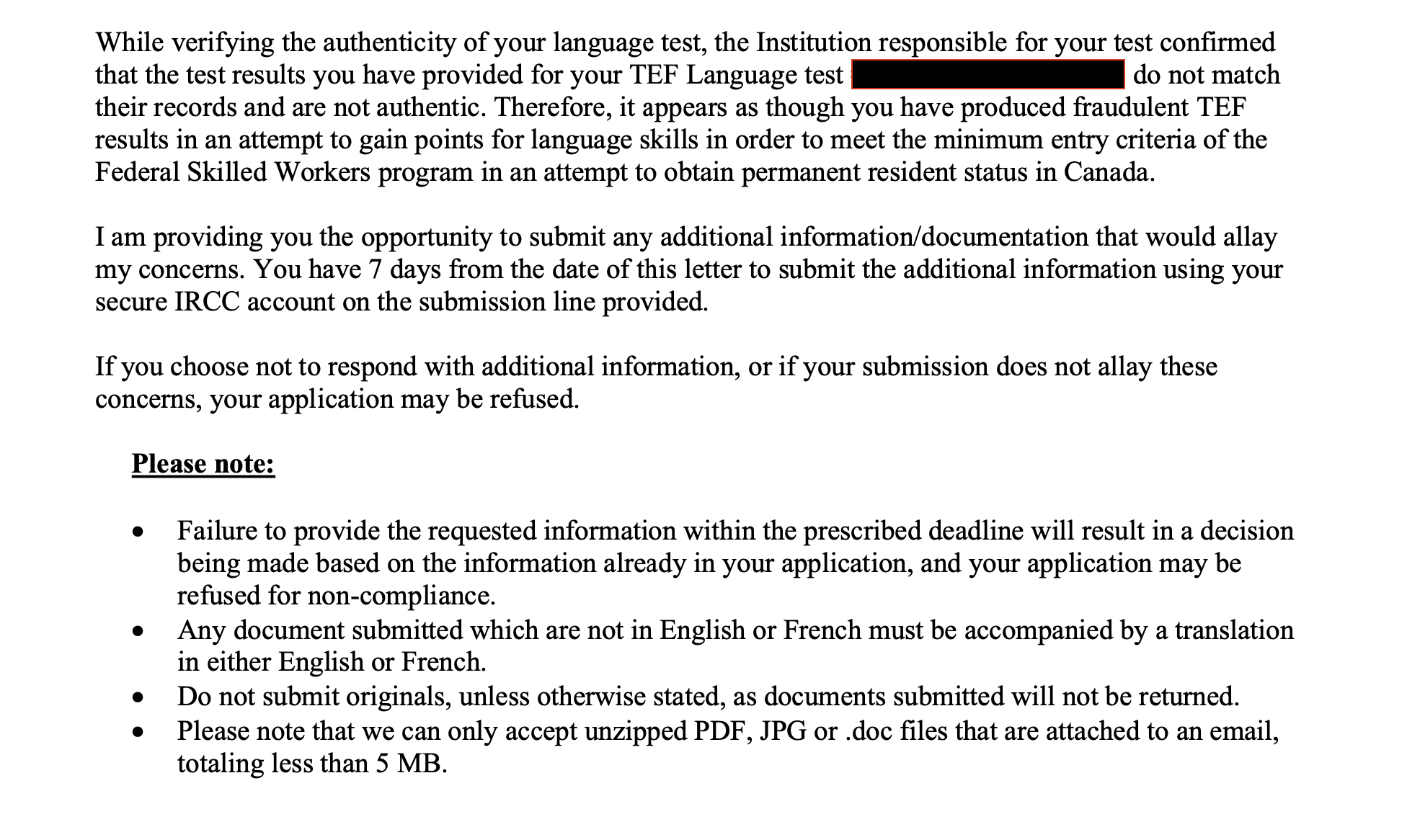
If IRCC suspects misrepresentation, they will issue a Procedural Fairness Letter, giving you a short deadline to respond with supporting documents. This is your final chance to clarify the issue before a decision is made.
Here is an example of a Procedural Fairness Letter where IRCC asked an applicant to prove their English test results were genuine. IRCC had already confirmed the test was invalid, giving the applicant a final chance to respond before a decision.
How to respond a procedural fairness letter misrepresentation?
Receiving a Procedural Fairness Letter (PFL) can be extremely stressful, and how you respond is crucial. Stay calm and seek guidance from an experienced immigration lawyer to protect your future in Canada.
Please review this article on how to respond to PFL letters
Get Free Consultation
By filling out the assessment form, our support team will contact you as soon as possible and help on how to overcome misrepresnation due to inadmissibility
Consequences and Penalties :
Canadian immigration authorities treat misrepresentation with the utmost seriousness. Potential outcomes include:
- Misrepresentation Ban Canada
A common penalty under Section 40(1) of the Act is a five-year ban from entering or re-entering Canada. During this period, you cannot work, study, or seek permanent residency. - Refusal of Current and Future Applications
A finding of misrepresentation cases in Canada can negatively affect your prospects for future applications, leading to repeated refusals. - Removal Orders
If you are in Canada and found to have misrepresented information, you may receive a removal order. Permanent residents sometimes have the right to appeal, while others must turn to the Federal Court. - Loss of Permanent Residency or Citizenship
If you obtained your status through Canada misrepresentation, authorities may revoke it. - Criminal Charges
In severe instances involving fraud or large-scale deception, charges may be pursued under Canadian law.
How to overcome inadmissibility due to misrepresentation IRCC?
- Judicial Review
You can challenge a refusal in the Federal Court if you believe it was unjustly reached. - Authorization to Return to Canada
If you have received an Exclusion Order, you may apply for an Authorization to Return to Canada before the five-year ban ends. - Temporary Resident Permit
Under specific circumstances, you may request a Temporary Resident Permit that allows you to reside or visit Canada for a prescribed length of time. - Humanitarian and Compassionate Application
If your personal circumstances are compelling, you may pursue relief under humanitarian and compassionate grounds.
What to Expect: Misrepresentation Case Timeline
Step | Description | Timeframe |
Step 1: Procedural Fairness Letter Issued | IRCC sends a letter outlining concerns of misrepresentation. | Response due in 15–30 days |
Step 2: Applicant’s Response | Applicant submits detailed explanations and supporting documents. | Within the response deadline |
Step 3: IRCC Decision | IRCC reviews the response and makes a decision. | Typically 30–90 days |
Step 4: Judicial Review or Appeal | If refused, applicant may challenge the decision. | File within 15 days (in Canada) or 60 days (outside Canada) |

How to apply for reconsideration IRCC
How to Apply for Reconsideration IRCC After a Visa Refusal ? Getting a visa refusal can be discouraging, but it doesn’t always mean the end of your Canadian journey. . This process asks the same visa officer or office to review your application again if an error was...
How to Strengthen Your Canadian TRV Application Amid Rising Canada Visa Rejections
Canada visa rejections have surged in 2024, sparking concerns among international students, temporary workers, and visitors. The Canada visa rejection rate increase highlights the importance of proving one’s intention to return home after a temporary stay. Below,...
10 Reasons for the rejection of Canadian Citizenship Applications
Canada is a primary destination for immigrants, offering a high quality of life and global opportunities. However, the journey to becoming a citizen isn’t without challenges. Many applicants face Canada citizenship rejection due to overlooked requirements or errors....

10 Essential Tips to Maintain Permanent Resident Status in Canada
If you're a permanent resident in Canada, maintaining your status requires ongoing effort and attention. Here are 10 essential tips to help you Maintain Permanent Residency Canada and navigate the complexities of Canadian immigration.If you're a permanent resident in...
Answers to Your Questions
What is considered misrepresentation in Canada?
Misrepresentation means giving false, incomplete, or misleading information to IRCC or CBSA, whether intentionally or by mistake.
Can a small or honest mistake still count as misrepresentation?
Yes. Even unintentional errors, like forgetting a past visa refusal, can lead to misrepresentation findings and serious consequences.
What happens if I ignore the Procedural Fairness Letter?
Ignoring it can result in a refusal, a five-year ban, or removal from Canada if you’re already inside the country.
How to Overcome Misrepresentation Inadmissibility in Canada with the Help of a Lawyer
Yes. A lawyer experienced in immigration law can help you prepare a persuasive response and avoid costly mistakes.
What if I believe IRCC made an error in their decision?
You can challenge it by filing for Judicial Review in Federal Court within a set deadline (15 days in Canada, 60 outside).